St Thomas of Canterbury, 30 November 2018

We started by giving the children an opportunity to play Picaria Quad, a game we invented as a family on 18 November 2018. This variation on Picaria gives each player four counters and the winner is the first to make a square or rectangle. We started by asking the children to find all the squares and rectangles on the board. They did well, but needed a bit of help to see the ones that are set at an angle.

We then played a few 5 in a row games. I describe Pentago, Cavendish and Pente in the blog posting below, so will avoid repetition here. It is interesting to see the similarities in how adults and children approach these games. Whatever the age, some players will approach with caution, mull over their options, and learn from their mistakes. Some will also throw themselves straight in and ignore your strategic tips. Although so far only the children have spontaneously hummed the Imperial March leitmotif from the Star Wars theme while playing.

Newport, 30 November 2018

Today at our Board Games Club for Adults we played two games based on making squares, and three 5 in a row games.

We played Squares (Waddingtons, 1982). This is a three dimensional version of the game sometimes called Dots and Boxes which is played on paper. The grid is 4 x 5, giving a total of 20 squares. Initial set-up has all the blocks turned to red on one side, and white on the other side. The player who is looking at red has to make a white square, and vice versa. Players take it in turns to swivel one block. Whoever swivels the last block to make a square claims it with a peg of their colour. The player with the most pegs at the end is the winner.

We also played Territorie (Invicta, 1979). Invicta made Mastermind, Anna’s favourite game, and we think they invented this game to give another use to the coloured pegs. They were a plastics company after all! In Squares, a block is permanent once a square is made. In Territorie a player has two options: either add a new fence to the 8 x 8 grid, or swing an existing fence in any direction. When a player encloses a square with a fence on all four sides they claim it with their own colour peg. Again, the player with the most pegs at the end is the winner.

The 5 in a row games we played were: Pente, Pentago and Cavendish.

Pente (Parker, 1984) uses a 19×19 grid and the game is played on the intersections. If this makes you think of the game Go, you clearly know your board games. There are two ways to win: make a 5 in a row, in any direction; or capture five pairs of the other player’s beads. The method of capturing is “custodian capture”: you bracket two adjacent beads with one of your own at both ends. The strategy includes trying to make a 4 in a row which is open at both ends: the other player can block one end on their turn, leaving you free to complete the five at the other end.

Pentago (Peliko, 2005) has a board that twists. On their turn each player does two things: add one marble of their colour to the board, then twist one quadrant of the board through 90º. The game board is constantly changing, and the key is to set up the board so that you twist it to make a 5 in a row on your next move, hoping the other player cannot see what you are about to do.

We played Cavendish (Hiron Ltd, 1986) last week but it is such a good game we brought it back. The strategy is the same as Pente: make a 4 in a row which is open at both ends. It also has a capturing rule, but this one involves jumping over not bracketing two counters.

St Thomas of Canterbury, 23 November 2018

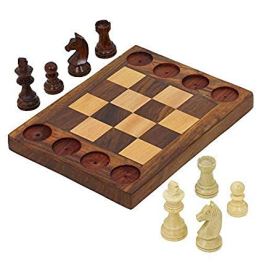
By request, we had a chess week. But not regular chess. We played Dice Chess! Pieces move and capture in the normal way, but a role of the die determines which piece is moved. 1 = pawn or king. 2 = pawn or king. 3 = queen. 4 = bishop. 5 = knight. 6 = rook. If a piece is missing or cannot legally move then the die is rolled again. A player wins by capturing the king. A player can check the king, but with the version we played the king is not obliged to move out of check (although it would be a gamble not to). You do not win by checkmate but by capturing the king. This variation is quicker than normal chess as there is less time spent agonising over which piece to move.

We also played a game I call Chess Four.

chess four

It is played on a 4×4 grid, with only one pawn, knight, bishop and rook each. The aim is to be the first to make a 4 in row. Pieces move and capture in the normal way, but a captured piece is given back to the player who lost in, who gets to reintroduce in when they choose. This is a good game for introducing children to how chess pieces move and capture.

Newport, 23 November 2018

Today at our Board Games Club for Adults we hosted the world premiere of ‘Picaria Quad’, a game we invented as a family on 18 November 2018. This variation on Picaria gives each player four counters and the winner is the first to make a square or rectangle. This game is part of our collection of board games that we will be selling soon. We are appearing at two primary school Christmas fairs, and people can try the games in the collection before buying them: they make excellent Christmas presents!

We also played some five in a row games. The first was Cavendish (Hiron Ltd, 1986) invented by Maureen Hiron. The winner is the first player to make a five in row. Unlike most ‘n in row’ games this one has a capture rule: if they are in a straight line, you can jump one of your counters over two of the other player’s counters and remove them. Although if you do too much capturing your counters will be spaced far apart and it will be harder work to make your five in a row.

We also played Cambio (Lagoon, 1996), another 5 in a row game by Maureen Hiron. There are wooden cubes which have a different symbol on each of the six sides. The cubes are arranged in a 5×5 grid. Each player selects a symbol, then pushes a new cube in from one side of the grid, moving each cube along by one and pushing a cube out of the other side. The limitation is that you are not allowed to push the player’s symbol out of the grid.

St Thomas of Canterbury, 16 November 2018

We started with Hex. It is a game which is easy to describe but not necessarily easy to play. It was invented by the Danish mathematician Piet Hein in 1942. It was independently invented by mathematician John Nash in 1947 at Princeton University. The board is a rhombus shape. Players must connect two opposite sides with pieces of their colour. There is a mathematical proof that this game cannot end in a draw. There are lots of resources online describing the strategy. You can play Hex online.

It is very difficult to buy this game so I printed paper boards. This might have been one reason why the children were reluctant to play it for too long. We moved on to Bridg-It (Hasbro, 1960). This variant of Hex was invented by mathematician David Gale. Players attempt to build a continuous connected bridge of their colour from one side of the board to the opposite side, while blocking their opponent from doing the same. When testing this game I could see the similarity to Hex and wondered if a game could ever end in draw. I searched online and found that the only way a bridge can be completely blocked is by completing a bridge of the opposite colour: draws are therefore impossible. You can play Bridg-It online.

Our final game was Quoridor (Gigamic, 1997). The aim is to be the first player to reach the opposite side of the board. On each move a player has two options: moving their pawn one square, or placing a fence. If you place a fence you can obstruct the other player and slow them down, but if you are not careful you can end up obstructing yourself. I will write more about this game when I have further explored games on the theme of mazes and labyrinths.