St Thomas of Canterbury, 23 November 2018

By request, we had a chess week. But not regular chess. We played Dice Chess! Pieces move and capture in the normal way, but a role of the die determines which piece is moved. 1 = pawn or king. 2 = pawn or king. 3 = queen. 4 = bishop. 5 = knight. 6 = rook. If a piece is missing or cannot legally move then the die is rolled again. A player wins by capturing the king. A player can check the king, but with the version we played the king is not obliged to move out of check (although it would be a gamble not to). You do not win by checkmate but by capturing the king. This variation is quicker than normal chess as there is less time spent agonising over which piece to move.

We also played a game I call Chess Four.
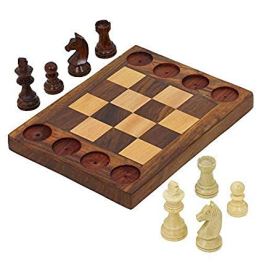
chess four

It is played on a 4×4 grid, with only one pawn, knight, bishop and rook each. The aim is to be the first to make a 4 in row. Pieces move and capture in the normal way, but a captured piece is given back to the player who lost in, who gets to reintroduce in when they choose. This is a good game for introducing children to how chess pieces move and capture.

Newport, 23 November 2018

Today at our Board Games Club for Adults we hosted the world premiere of ‘Picaria Quad’, a game we invented as a family on 18 November 2018. This variation on Picaria gives each player four counters and the winner is the first to make a square or rectangle. This game is part of our collection of board games that we will be selling soon. We are appearing at two primary school Christmas fairs, and people can try the games in the collection before buying them: they make excellent Christmas presents!

We also played some five in a row games. The first was Cavendish (Hiron Ltd, 1986) invented by Maureen Hiron. The winner is the first player to make a five in row. Unlike most ‘n in row’ games this one has a capture rule: if they are in a straight line, you can jump one of your counters over two of the other player’s counters and remove them. Although if you do too much capturing your counters will be spaced far apart and it will be harder work to make your five in a row.

We also played Cambio (Lagoon, 1996), another 5 in a row game by Maureen Hiron. There are wooden cubes which have a different symbol on each of the six sides. The cubes are arranged in a 5×5 grid. Each player selects a symbol, then pushes a new cube in from one side of the grid, moving each cube along by one and pushing a cube out of the other side. The limitation is that you are not allowed to push the player’s symbol out of the grid.