St Thomas of Canterbury, 22 March 2019

At Bletchley Juniors Codebreaking Club this week we covered naval flag codes. The first activity I gave the children was to make a set of flags for the digits 0-9. I had printed sets of coloured flags which I then cut up so that the children were left with lots of red, blue, yellow, white and black pieces which they had to fit together and then glue on to backing card. The next activity was to decode a printed message: I had swapped some of the letters for the appropriate naval flag. Each message contained a problem e.g. hungry rats have eaten the mainsail! The children then had to find the problem in a codebook I had made and find the solution, then match these to code-numbers. The final activity was to set their flags to match the code-numbers, and send a message across the hall to another ship: the children on this ship looked up the code-numbers in their codebook to find the solution and send the item (in this case a new mainsail) across the room.

The children really enjoyed these activities. They liked the hands-on, problem solving element of making their flags, and it was the first time they had used a codebook. One parent was particularly thrilled as their father was in the navy as a signaller so it provided a nice link to their past.

flags

Newport, 22 March 2019

This week at our Adults Board Games Club we played a new game for us, Abalone. We think the game has promise, but were hampered by Anna’s post-flu fuzzy brain, and some very badly translated instructions. We had a couple of games of Mancala to make up for it.

St Thomas of Canterbury, 15 March 2019

This week at Bletchley Juniors Codebreaking Club I arranged a codebreaking challenge. This was a recap of some of the codes we have explored to date (Pigpen, Caesar Shift, Polybius Square) for the children who have attended since the first week, and new material for the children who have only recently joined us. I split the children into four teams, which I named after Greek gods and goddesses (Zeus, Hera, Athena and Hermes). (This club is rapidly turning into a crash course in Greek mythology!).

The first challenge was to decode sentences describing an animal, then draw the answer. The second challenge was a treasure hunt: I had hidden envelopes around the hall and the decoded message told the children where to look. The third challenge involved deciding which of a set of Medieval objects was the oldest (sets included crowns, swords, arrows and shields).

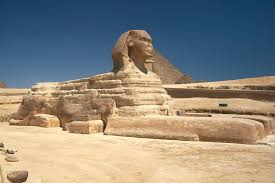
Further challenges included: addition and subtraction questions; sentences describing Luke Skywalker (e.g. I have a twin sister); deciding which shape is not symmetrical; deciding which number comes next in a sequence; and adding a nought and a cross to make a pattern symmetrical. One team even got as far as decoding the Riddle of the Sphinx, and having a go at figuring it out.

Overall this was another very enjoyable week, with a real buzz in the room when the children brought me their answers to check and collect their next challenge.

sphinx

Newport, 15 March 2019

At our Adults Board Games Club, this was our first week in our new venue, Caffé Isola in St James Street. We sit upstairs for those who are thinking of joining us. We welcomed a new member and played Five Field Kono (a replacement game from Korea) and Moving Tigers (an asymmetric capture game from Nepal).

St Thomas of Canterbury, 8 March 2019

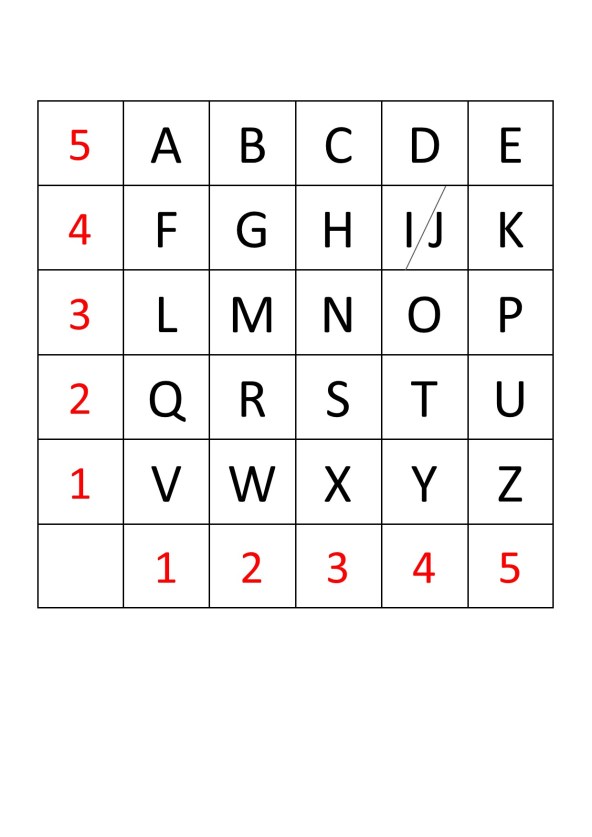
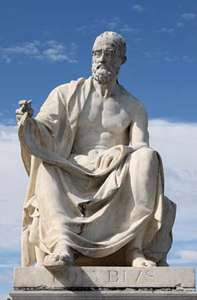
I keep on taking the children back to the Ancient World in Bletchley Juniors Codebreaking Club, and this week was no exception as we went to Ancient Greece. Polybius (c200 BC to c118 BC) was a historian who developed a substitution cipher using a grid and coordinates. I sneaked in a little bit of maths by asking the children what a square number is. We recapped all the squares numbers up to 6 x 6. I asked how many letters there are in the alphabet. When I got the answer of 26 I asked which square number is closest. The children were very quick to answer 5 x 5 =25. I explained that Polybius used a 5 x 5 grid which he filled with each letter of the alphabet. On the whiteboard I stuck a grid I had prepared earlier. I pointed out that two letters need to share a cell as 26 is one more than 25: these two letters are I and J. (With Polybius the Greek alphabet had 24 letters so he had one cell left empty). I pointed out that the grid has the numbers 1 to 5 along the bottom and also up the side.

Polybius2

I then used an example to practise with:

32 / 53 / 22 / 44 / 33 / 24       44 / 32      34 / 55 / 22 / 55

I explained that the first number (3 in this example) means go to 3 on the numbers along the bottom (or the x axis for those of us who can’t resist a bit of maths), and that the second number (2 in this example) means go to 2 on the numbers up the side (that will be the y axis). Where the two numbers meet is the letter, in this case ‘s’. The whole example decodes as ‘spring is here’. We then practised turning a word into code, using ‘code’ as the example. It encodes as 35 / 43 / 45 / 55.

I gave each child their own ciphertext to decode. The challenge was to work out what the words had in common. One was on Lego, another was Lego Brands. Others were mythical creatures, steam locomotives, Disney princesses, maps, Minecraft and Power Rangers. Yes, each child had a ciphertext which matched their interests! For those that finished early, I had other ciphertexts based on recipes for slime and jelly worms, but this time using a 6 x 6 Polybius Square, which happily has space for all the letters of the alphabet and every digit from 0 to 9 . I have since learnt from a parent that one child spent time at the weekend finishing decoding their ciphertext as they enjoyed it so much: truly a thumbs up for us!

polybius
He loved squares