St Thomas of Canterbury, 17 May 2019

At Bletchley Juniors Codebreaking Club this week I introduced the children to a Cardan Grille, making sure they knew that this use of the grille refers to a type of window not to a way of cooking sausages.

I explained that the grille can be used eight different ways i.e. it has two faces, and can be rotated four times.  The activity this week was collective nouns e.g. a pride of lions. I prepared squares containing 36 letters in a 6 x 6 square. I made grilles with 12 windows. I arranged the letters so that in only one of the eight possible options was there a word that made sense. The words were all the nouns i.e. animals, birds or fish. Once the children had decoded the set of nouns, I gave them pictures to match to the nouns.

cardan grille2
My grille looked a bit like this, except with 12 windows. 

The next task was to decode the collective words. I had encoded these using Shadow’s Code, which we used several weeks ago but had not been seen by some of the children who have joined our club since then. Once the collective words were decoded, the children had to match this to the noun.  This was the hardest part of the activity and required a bit of a steer from us. 

Some of our favourite collective nouns were: a smack of jellyfish; a crash of hippos; a shiver of sharks, and a fever of stingrays.
Newport, 17 May 2019

We played Backgammon again this week at our Adults Board Games Club. We also played Nine Men’s Morris. One game of Backgammon was the closest and most exciting at the end that one of our members had experienced. It all came down to the roll of the dice.

St Thomas of Canterbury, 10 May 2019

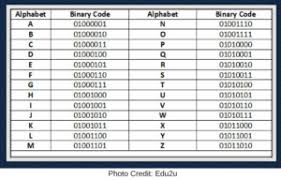
At Bletchley Juniors Codebreaking Club this week we explored Binary Code. I explained how computers use binary code to send and receive information, using a series of 1s and 0s to encode letters and numbers. We used UTF-8 as our binary code, so I explained that each 1 and 0 is a bit, and eight bits make a byte. We talked briefly about the difference between megabytes, gigabytes and terabytes.

binary

Our activity was to make a name chain using beads. I showed them an example of one I had made earlier for my name. I got the children to write out their name (first name and surname) on paper, then encode it in binary code. Using black beads to represent the 1s and white beads to represent the 0s, I got the children to thread the beads onto a piece of nylon string. To make it easier to decode later, and easier to check for mistakes, the children put a coloured bead between each byte (letter). Some children had time to make a chain featuring both their first name and surname, others only their first name. The children seemed to really enjoy this activity: I could sense they were ‘in the moment’ as they threaded their beads according to whether the bit was a 1 or a 0.

One child noticed that we were doing Binary Code on 10 May, and asked if this was on purpose i.e. the binary digits 1 and 0 matching the date. I could have pretended I had done it by design, but I confessed that it was a coincidence!