Perplexing paperclips at the Curious Minds Club (St Thomas of Canterbury Primary School, 18 October 2019)

We did some perplexing things with paperclips and rubber bands this week. I showed the children how to bend a long strip of paper into an ‘s’ shape, then squash it together and add two paperclips at the two places where the paper touches. When I pulled on each end of the paper the children were surprised to see the two paperclips land on the table linked together.

The children then followed a set of drawings I had made, each one getting progressively harder and involving adding in one rubber band, then two rubber bands, then changing the positions of the bands along the strip of paper. The results were a combination of the paperclips and rubber bands being linked together in lots of different ways, some falling off the paper and some staying on. Some children made it to drawing 10, which results in an amazing Borromean link!

If you want to see how the paperclips become linked together, here is a slow motion video:

This is what the table looked like at the end! Lots of mess and lots of fun.
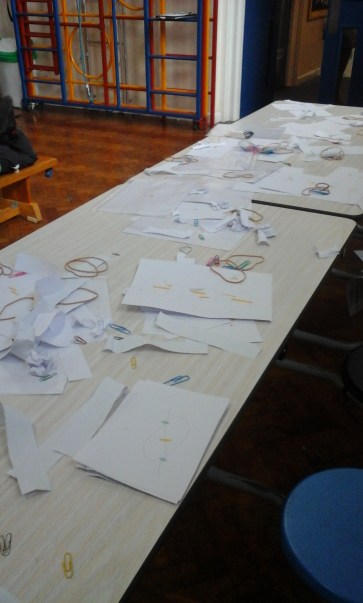
Table after Perplexing Paperclips 18 October 2019

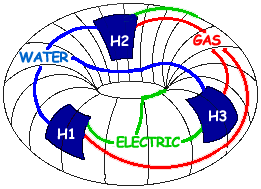
The Three Utilities Problem at the Curious Minds Club (St Thomas of Canterbury Primary School, 11 October 2019)

An investigation of that classic problem in topology, the Three Utilities Problem. The children made their first attempt in flat, two-dimensional space i.e. on a mini whiteboard, so they could rub out their attempts and keep trying. After a few minutes I explained that the problem cannot be solved in two-dimensional space as there is not enough space! I asked the children what we could do in this case, and one boy was very quick to suggest trying it in three-dimensional space.

I produced four big tori, in the form of an inflated swim ring which I had wrapped in white duck tape and labelled, so that the dry wipe markers could be used and rubbed off as needed. After a few attempts, and some hints from me that they needed to use the whole length and circumference of the torus, we had some correct solutions.

three utilities

I then reminded the children that a torus is topologically equivalent to a coffee mug, and that if they could solve this problem on a torus they could also solve it on a mug. I then produced four white mugs which I had labelled. The dry wipe markers rub off very easily on a mug. The children spent the rest of the session exploring how to solve the problem. They needed a few hints about using the handle and the base, and going under the handle, but most of them got there in the end. The children seemed to really enjoying solving the problem using such unusual materials.

three utilities mug

Mobius loops at the Curious Minds Club (St Thomas of Canterbury Primary School, 4 October 2019)

We explored the Mobius loop in this week’s Curious Minds Club. The children made a straight loop and drew lines around the centre of the paper strip on the inside and the outside to prove the loop has two faces. They did the same along the edges to prove the loop has two edges. I showed they how to introduce a half twist, and how this changes the property of the new Mobius loop to only having one face and one edge.

The children cut the Mobius loop along its centre line to show that it does not fall into two pieces as expected, but becomes a loop with four half twists. I asked the children to predict what would happen if they cut a Mobius loop one third of the way in: some predicted two loops, and some predicted one twisted loop. They made the cut and were surprised to make two connected loops, one Mobius and one non-Mobius.

The next experiment was to connect together two straight Mobius loops. No one predicted that the result would be a square. Our final experiment was to connect together two Mobius loops of opposite chirality, one with a right half twist and one with a left half twist. The delightful result was two interconnected hearts!