Starting to build the Platonic Solids at the Curious Minds Club (St Thomas of Canterbury Primary School, 24 January 2020)

This week at the Curious Minds Club we focused on three dimensional space by starting to build the Platonic Solids.

I gave the children some Polydron equilateral triangles and showed them the net of a tetrahedron. They were able to build one quite quickly, then form it into a three dimensional object. Next up was the cube. Before handing them the pieces I asked the children if they could work out the cube’s alternative name, based on it having six faces. With a little prompting to think about which two dimensional object has six sides, one girl correctly suggested ‘hexahedron’. The children then constructed their Polydron cubes. I did not show them all 11 nets of a cube (an activity for a later date?) but let them figure it out for themselves. The next was the octahedron. I gave each child eight equilateral triangles and told them that four triangles meet at each vertex. They found this a little harder and I showed them one I had made earlier as a guide.

I decided to leave the final two Platonic solids (the dodecahedron and icosahedron) to next week as I thought it would be too much to attempt all five in one session. I got out some magnetic rods and balls (similar to Geomag but a generic version) and asked the children to make the tetrahedron, cube and octahedron in this material. The Polydron pieces are good at bringing out each face of the solid, but the generic Geomag are better at bringing out the vertex and edge.

Some of the children built quite large cubes with three rods forming an edge. They soon discovered that this made a wobbly and unstable cube, due to the degrees of freedom in a square. I encouraged them to use one rod for an edge, and they had more success this way.

Below are some of the children’s creations:
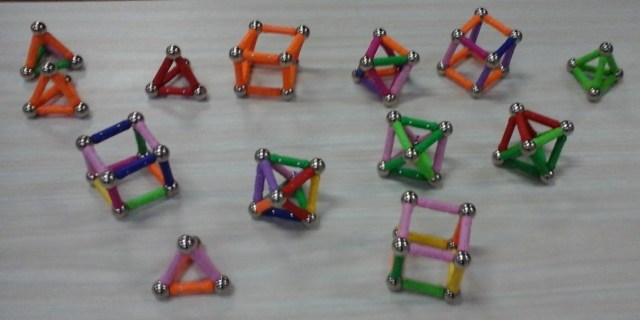
Collection Platonic Solids1

Collection Platonic Solids2

I had prepared some material on the symmetry of the Platonic solids. I showed one girl how to look at each object in three ways: face on, edge on and vertex on. I gave her two dimensional pictures of each object and a piece of mirror card, and asked her to find the lines of reflective symmetry for each object. She did really well at this activity and seemed to really enjoy looking at the objects in different ways.

We finished with a quick game of Dotty Dinosaurs. This week we played the colour matching version as a memory game.

Regular and irregular pentagons at the Curious Minds Club (St Thomas of Canterbury Primary School, 17 January 2020)

This week at the Curious Minds Club we continued our exploration of shapes, in two and three dimensions of space, by looking at (regular) pentagons. The children were able to identify that pentagons do not fit together without leaving a gap or an overlap.

pentagon problem

I showed them how to cut two irregular pentagons out of a regular hexagon. They made a set and explored how to get them to tessellate with all the edges meeting at a vertex. The solution involved flipping some of the tiles over.

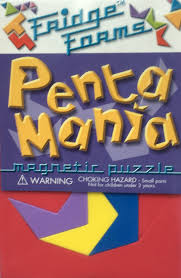
I gave one group the puzzle called Pentamania to explore. This is a set of 54 so called folded pentagons. Two can be seen in the image above (one pink, one grey) when regular pentagons overlap. The children solved one of the three puzzles and enjoyed making a pattern with the pieces.

pentamania

Y6 girl PentaMania

A group of younger children enjoyed a quick game of Dotty Dinosaurs. They played the shape matching version.

dotty dinosaurs

We then made our first three dimensional object, a tetrahedron. I wanted to see how the children managed with the Polydron pieces I had, as they can be a little tricky for small hands to clip together. The children managed the activity well. One girl asked if she could take it home, so she must have liked it. I asked them what the object was called. One boy correctly said a triangle-based pyramid. They were all intrigued to learn its second name, the tetrahedron. I explained that tetra meant four in Ancient Greek, and this object has four faces.

. tetrahedron

We finished by getting out the pattern blocks from last week, and completing some of the pattern boards. Here are a selection:


Two dimensional tessellations at the Curious Minds Club (St Thomas of Canterbury Primary School, 10 January 2020)

In this new term at the Curious Minds Club we started our exploration of shapes, in two and three dimensions of space.

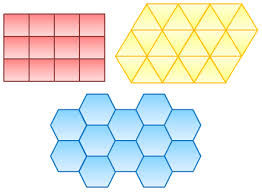
I gave the children a collection of wooden triangles, squares and hexagons. I asked them to make a regular, edge to edge tessellation for each shape. It didn’t take long for every child to find the solutions:

regular tessellations

I explained that each tessellation has a vertex notation. I started with the square tessellation, explaining that its notation is 4,4,4,4 (every vertex is surrounded by a shape with four edges i.e. a square). I asked the children to work out the notation for the other two tessellations. With a little help they were able to find the answers: 3,3,3,3,3,3 and 6,6,6.

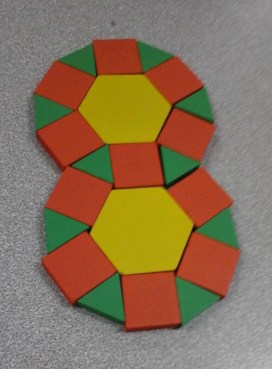
We then moved on to the semi-regular tessellations, of which there are eight. I used the same wooden pieces and some pieces that I had to cut out of card (octagons and dodecagons) as they are not available in wood. I gave each child a different vertex notation (e.g. 3,6,3,6 to make the pattern in the top left corner below) and asked them to put the pieces in the right order. When I had checked they had got it right (or offered a bit of help) I encouraged each child to take more pieces and extend the pattern out in each direction. I then rotated the activity between the children so they all got to try as many of the eight tessellations as possible.

semi regular tessellations

Here are some examples of completed tessellations:

3,4,6,4 tessellation by a Year 4 girl:

Y4 girl tessellation 3 4 6 4

3,3,4,3,4 tessellation by a Year 6 boy:

Y6 boy tessellation 3 3 4 3 4

3,12,12 tessellation by a Year 6 girl:

Y6 girl tessellation 3 12 12

For our final activity I gave each child a sheet showing all eight semi-regular tessellations and a piece of mirror card, and asked them to find the reflection symmetry for each tessellation (some have more than one). I asked them to find the ‘odd one out’. One boy was successful in identifying that 3,3,3,3,6 has no reflection symmetry. I explained that this is because it is chiral i.e. there are two different versions of it: