
At our Adults Board Games Club, this was our first week in our new venue, Caffé Isola in St James Street. We sit upstairs for those who are thinking of joining us. We welcomed a new member and played Five Field Kono (a replacement game from Korea) and Moving Tigers (an asymmetric capture game from Nepal).
St Thomas of Canterbury, 8 March 2019
I keep on taking the children back to the Ancient World in Bletchley Juniors Codebreaking Club, and this week was no exception as we went to Ancient Greece. Polybius (c200 BC to c118 BC) was a historian who developed a substitution cipher using a grid and coordinates. I sneaked in a little bit of maths by asking the children what a square number is. We recapped all the squares numbers up to 6 x 6. I asked how many letters there are in the alphabet. When I got the answer of 26 I asked which square number is closest. The children were very quick to answer 5 x 5 =25. I explained that Polybius used a 5 x 5 grid which he filled with each letter of the alphabet. On the whiteboard I stuck a grid I had prepared earlier. I pointed out that two letters need to share a cell as 26 is one more than 25: these two letters are I and J. (With Polybius the Greek alphabet had 24 letters so he had one cell left empty). I pointed out that the grid has the numbers 1 to 5 along the bottom and also up the side.
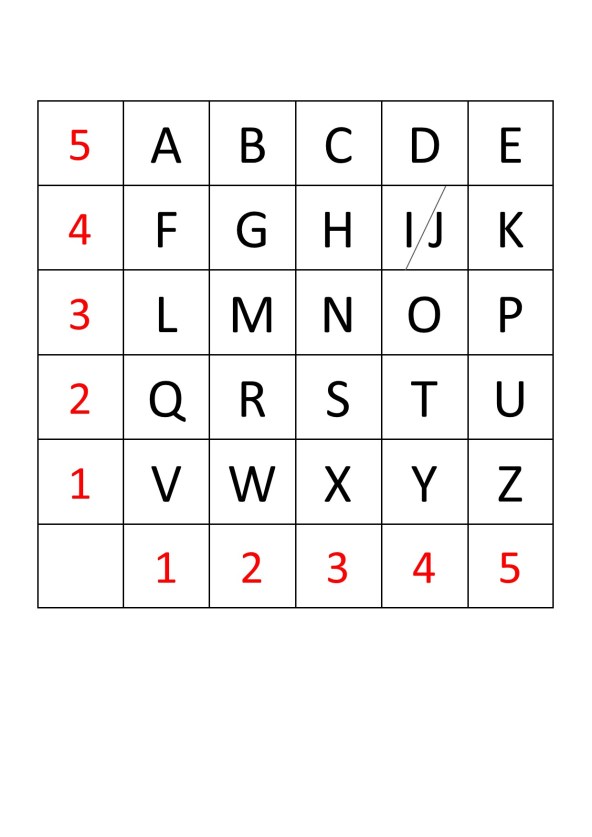
I then used an example to practise with:
32 / 53 / 22 / 44 / 33 / 24 44 / 32 34 / 55 / 22 / 55
I explained that the first number (3 in this example) means go to 3 on the numbers along the bottom (or the x axis for those of us who can’t resist a bit of maths), and that the second number (2 in this example) means go to 2 on the numbers up the side (that will be the y axis). Where the two numbers meet is the letter, in this case ‘s’. The whole example decodes as ‘spring is here’. We then practised turning a word into code, using ‘code’ as the example. It encodes as 35 / 43 / 45 / 55.
I gave each child their own ciphertext to decode. The challenge was to work out what the words had in common. One was on Lego, another was Lego Brands. Others were mythical creatures, steam locomotives, Disney princesses, maps, Minecraft and Power Rangers. Yes, each child had a ciphertext which matched their interests! For those that finished early, I had other ciphertexts based on recipes for slime and jelly worms, but this time using a 6 x 6 Polybius Square, which happily has space for all the letters of the alphabet and every digit from 0 to 9 . I have since learnt from a parent that one child spent time at the weekend finishing decoding their ciphertext as they enjoyed it so much: truly a thumbs up for us!
St Thomas of Canterbury, 1 March 2019
In previous weeks at Bletchley Juniors Codebreaking Club we have been to Ancient Greece and Ancient Rome. This week we went to Ancient Egypt and explored hieroglyphs. I explained that hieroglyphs: were used for writing about kings, queens and gods, and were carved onto the walls of temples, and onto tombs, statues and monuments; took the form of pictures not letters; did not use punctuation such as full stops and spaces between words, making them hard to read; and were sometimes written left to right and sometimes written right to left, adding to the difficulty in reading them.
I explained how the knowledge of hieroglyphs was lost after the Ancient Greeks invaded Egypt and that no one could read them hundreds of years, so that they effectively became a secret code that needed to be deciphered. I explained the breakthrough made by Champollion when he realised that some hieroglyphs represented sounds.
I gave the children each a key and used the names of several Ancient Egyptian gods as examples to decode with the children. These were:
Ra (pronounced ray), the sun God.
Osiris, the God of Death and the judge of the dead.
Horus, the son of Osiris and Isis and the God of the sky.
Seth, the jealous brother of Osiris who killed Osiris and was the God of chaos, darkness and storms.
Anubis, the God who watched over the dead.
Thoth (my favourite), the God of knowledge and wisdom and the inventor of hieroglyphs.
After we had finished the practice I gave each child their ciphertext, which took the form of a riddle e.g. what has to be broken before you can use it? An egg.
The second activity involved me bringing out a “here’s one I made earlier”, in the form of a cartouche: for one day I was Queen Debbie, having drawn my name in hieroglyphs and coloured it in (I was quite pleased with my vulture). I gave each child a blank cartouche I had cut out of some rather nice, thick card I happened to find in our arts and crafts box (no expense spared). Each child drew and coloured their first name in hieroglyphs. Some even went onto the back to do their surname. Some of the children have an ‘L’ in their name, which meant they had to draw a lion. We had some magnificent lions, with bright red lions and tails.
There was a really nice buzz during this session. The children seemed to really enjoy the visual element of decoding their hieroglyph ciphertext, and also having something to make and take home in the form of a cartouche.
Newport, 1 March 2019
Today at our Adult Board Games Club we welcomed a new member and introduced them to Mancala. See my previous blog posting for a description of one of the oldest games in the world. Our new member really enjoyed Mancala: we agreed that it is not like any other game.
Other games played this week were Pente, Nine Men’s Morris, Five Field Kono and Four Field Kono.
Half Term Family Event in Newport, 22 February 2019
We were pleased to meet two new families at today’s event, as well as seeing some familiar faces.
We played a selection of ancient games (Picaria, Five Field Kono), 1980s classics (Space Faces, Stay Alive, Rubik’s Race), and modern games (Ghost Blitz, Rainbow Rage, Acquisition, Spot It Jr.! Animals, Frog Rush).
All these different types of games were popular, some for the speed of thought processes, some for working out the best strategy, and some for grappling with the luck of the dice.
This was a successful event, with all the families telling us how much they enjoyed the chance to play games new to them.
 Games4Life