Knot theory and the handcuffs puzzle at the Curious Minds Club (St Thomas of Canterbury Primary School, 8 November 2019)

We started Knot Theory in this week’s Curious Minds Club. The first activity was the Handcuffs Puzzle: in pairs both children had a length of rope attached to their wrists in such a way that they were linked to their partner; the challenge was to untangle themselves. It looks like the length of rope forms a closed loop for each child, but the solution lies in realising that there is a gap under each wrist: if a loop is threaded through in the right direction, passed over the fingers and back over the wrist again then the two pieces of rope do become detached. The children had fun trying this out, but I did need to show them the solution.

The next activity was to challenge the children to tie a knot in a length of rope without letting go of either end. I demonstrated that holding a length of rope in each hand forms a closed loop and that if you do not let go you end up tying your arm into the knot. The children were pleased when I showed them there is a solution which involves tying your arms into a knot before picking up the rope, then unknotting your arms. This works on the principle of the transference of curves: when you unknot your arms you transfer the knot that was on your arms onto the rope.

The final activity was to start to explore some mathematical knots. I had attached velcro to the ends of some shoelaces so that the ends could be joined. The children made the 3,1 (the trefoil) then the 5,1 and the 7,1. They made one crossing change and saw how this allowed them to transform their knot into the previous one in the series.
Perplexing paperclips at the Curious Minds Club (St Thomas of Canterbury Primary School, 18 October 2019)

We did some perplexing things with paperclips and rubber bands this week. I showed the children how to bend a long strip of paper into an ‘s’ shape, then squash it together and add two paperclips at the two places where the paper touches. When I pulled on each end of the paper the children were surprised to see the two paperclips land on the table linked together.

The children then followed a set of drawings I had made, each one getting progressively harder and involving adding in one rubber band, then two rubber bands, then changing the positions of the bands along the strip of paper. The results were a combination of the paperclips and rubber bands being linked together in lots of different ways, some falling off the paper and some staying on. Some children made it to drawing 10, which results in an amazing Borromean link!

If you want to see how the paperclips become linked together, here is a slow motion video:

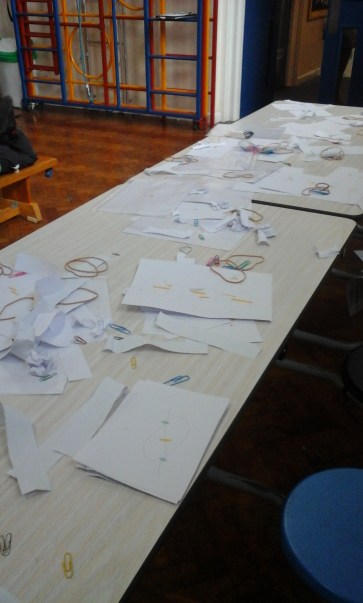
This is what the table looked like at the end! Lots of mess and lots of fun.

Table after Perplexing Paperclips 18 October 2019

The Three Utilities Problem at the Curious Minds Club (St Thomas of Canterbury Primary School, 11 October 2019)

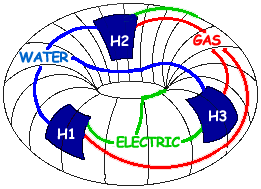
An investigation of that classic problem in topology, the Three Utilities Problem. The children made their first attempt in flat, two-dimensional space i.e. on a mini whiteboard, so they could rub out their attempts and keep trying. After a few minutes I explained that the problem cannot be solved in two-dimensional space as there is not enough space! I asked the children what we could do in this case, and one boy was very quick to suggest trying it in three-dimensional space.

I produced four big tori, in the form of an inflated swim ring which I had wrapped in white duck tape and labelled, so that the dry wipe markers could be used and rubbed off as needed. After a few attempts, and some hints from me that they needed to use the whole length and circumference of the torus, we had some correct solutions.

three utilities

I then reminded the children that a torus is topologically equivalent to a coffee mug, and that if they could solve this problem on a torus they could also solve it on a mug. I then produced four white mugs which I had labelled. The dry wipe markers rub off very easily on a mug. The children spent the rest of the session exploring how to solve the problem. They needed a few hints about using the handle and the base, and going under the handle, but most of them got there in the end. The children seemed to really enjoying solving the problem using such unusual materials.

three utilities mug

Mobius loops at the Curious Minds Club (St Thomas of Canterbury Primary School, 4 October 2019)

We explored the Mobius loop in this week’s Curious Minds Club. The children made a straight loop and drew lines around the centre of the paper strip on the inside and the outside to prove the loop has two faces. They did the same along the edges to prove the loop has two edges. I showed they how to introduce a half twist, and how this changes the property of the new Mobius loop to only having one face and one edge.

The children cut the Mobius loop along its centre line to show that it does not fall into two pieces as expected, but becomes a loop with four half twists. I asked the children to predict what would happen if they cut a Mobius loop one third of the way in: some predicted two loops, and some predicted one twisted loop. They made the cut and were surprised to make two connected loops, one Mobius and one non-Mobius.

The next experiment was to connect together two straight Mobius loops. No one predicted that the result would be a square. Our final experiment was to connect together two Mobius loops of opposite chirality, one with a right half twist and one with a left half twist. The delightful result was two interconnected hearts!

Fitting the body through a piece of card at the Curious Minds Club (St Thomas of Canterbury Primary School, 27 September 2019)

Another activity to demonstrate that topology includes changing an object’s shape without changing its size. I challenged the children to see if they could fit their body through a piece of A4 card. They looked baffled. I asked them what tools they could use. They correctly offered cutting and folding. I showed them this method, which uses one fold and lots of alternate cuts. There were a few false starts but all the children did manage to complete the task, much to their satisfaction. I then challenged them to fit their body through a postcard, using the same method but this time making narrower cuts. Despite their scepticism the children were able to complete this task (with a bit of help at times). The ultimate challenge was to fit their body through the paper equivalent of a bank card. This was really tricky as the cuts have to be so narrow they are prone to snapping. We did have several successes, all showing a lot of persistence. We all had lots of fun exploring the topology of a piece of card.