St Thomas of Canterbury, 29 March 2019

At Bletchley Juniors Codebreaking Club this week we explored codes using simple household items, namely a paperclip and some tracing paper.

For the paperclip code I had prepared lots of pairs of words e.g. blood and guts, skull and crossbones, Romeo and Juliet. I encoded each word on a separate piece of paper and mixed up all the words. After decoding the words the children (working in teams of two) had to match up their pairs.

For the second activity I chose the page of a book and traced over a sequence of letters which spelt out a question. After decoding the question, I gave the children a blank sheet of tracing paper and they encoded their answer, which I then decoded.

Newport, 29 March 2019

We played Chinese Chequers this week at our Adults Board Games Club, at the request of one of our members. We played as a three, with everyone trying to get to an empty position opposite them. We used the strategies of building ladders and zigzagging. Anna won, and to give her some credit it wasn’t even close.

We played a new game for us, Color Addict (an American game, not a typo by me). On each card is the word of a colour which can be written in several different colours. You match the correct colour, or the correct word, or both, or vice versa. The game is constantly changing, and wildcards can also be used when needed (and if you have one). The winner is the first to play all their cards. I do enjoy a fast paced card game.

We ended with a couple of rounds of the ever popular Mancala.

St Thomas of Canterbury, 22 March 2019

At Bletchley Juniors Codebreaking Club this week we covered naval flag codes. The first activity I gave the children was to make a set of flags for the digits 0-9. I had printed sets of coloured flags which I then cut up so that the children were left with lots of red, blue, yellow, white and black pieces which they had to fit together and then glue on to backing card. The next activity was to decode a printed message: I had swapped some of the letters for the appropriate naval flag. Each message contained a problem e.g. hungry rats have eaten the mainsail! The children then had to find the problem in a codebook I had made and find the solution, then match these to code-numbers. The final activity was to set their flags to match the code-numbers, and send a message across the hall to another ship: the children on this ship looked up the code-numbers in their codebook to find the solution and send the item (in this case a new mainsail) across the room.

The children really enjoyed these activities. They liked the hands-on, problem solving element of making their flags, and it was the first time they had used a codebook. One parent was particularly thrilled as their father was in the navy as a signaller so it provided a nice link to their past.

flags

Newport, 22 March 2019

This week at our Adults Board Games Club we played a new game for us, Abalone. We think the game has promise, but were hampered by Anna’s post-flu fuzzy brain, and some very badly translated instructions. We had a couple of games of Mancala to make up for it.

St Thomas of Canterbury, 15 March 2019

This week at Bletchley Juniors Codebreaking Club I arranged a codebreaking challenge. This was a recap of some of the codes we have explored to date (Pigpen, Caesar Shift, Polybius Square) for the children who have attended since the first week, and new material for the children who have only recently joined us. I split the children into four teams, which I named after Greek gods and goddesses (Zeus, Hera, Athena and Hermes). (This club is rapidly turning into a crash course in Greek mythology!).

The first challenge was to decode sentences describing an animal, then draw the answer. The second challenge was a treasure hunt: I had hidden envelopes around the hall and the decoded message told the children where to look. The third challenge involved deciding which of a set of Medieval objects was the oldest (sets included crowns, swords, arrows and shields).

Further challenges included: addition and subtraction questions; sentences describing Luke Skywalker (e.g. I have a twin sister); deciding which shape is not symmetrical; deciding which number comes next in a sequence; and adding a nought and a cross to make a pattern symmetrical. One team even got as far as decoding the Riddle of the Sphinx, and having a go at figuring it out.

Overall this was another very enjoyable week, with a real buzz in the room when the children brought me their answers to check and collect their next challenge.
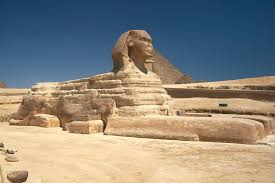
sphinx