St Thomas of Canterbury, 28 June 2019

At Bletchley Juniors Codebreaking Club this week we tried three new ciphers!

Our first was the Atbash cipher. I encoded a group of words and asked the children to work out the connection between the words. I used these groups: DC Comics superheroes, the sun, the moon, and the Seven Wonders of the Solar System. This last one had a ‘match the picture’ round. I explained that I chose the moon as it is nearly 50 years since a man first landed on the moon. The words in my moon group were: full, half, Apollo, lunar, crescent, gibbous, waxing and waning.

The second was the Jefferson cipher wheel. I was in possession of a replica wheel. I showed the children that each disk has a random sequence of each letter of the alphabet, which can be removed and replaced in an agreed order. The plaintext is then spelled out on one row of the wheel. Every other row will look like gibberish. One of these rows is chosen as the ciphertext. The recipient of the coded message sets their wheel to the ciphertext and turns the wheel around until they find the one row which make sense, which is the plaintext. The activity was to decode the Seven Wonders of the Ancient World, then match each to its picture. The children found it quite hard to manipulate the wheel: some of the disks were stiff and hard to turn, and others were a little too loose. This made it hard to line up each row in a straight line. With some help the children were able to decode the Great Pyramid of Giza and the Colossus of Rhodes. As we were running out of time I read out the names of the other five wonders, and we went straight to the pictures to match everything up.

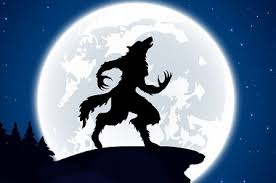
Our third cipher was the Ancient Runes. There were some mythological beasts and monsters that we did not have time to look at last week, so I reused them and encoded them in the Runes. I do love a ‘match the picture’ round so included one here. After decoding such beasts as the Basilisk, Manticore, Chimera, Werewolf and Griffin the children were successful in matching it all up.
werewolf

St Thomas of Canterbury, 21 June 2019

At Bletchley Juniors Codebreaking Club this week we used the Date Shift Cipher. I chose some famous dates from history e.g. Shakespeare’s Date of Death, the Battle of Hastings and The Fall of the Berlin, and turned the date into a repeating keyword. I explained that this was another example of a polyalphabetic substitution cipher.

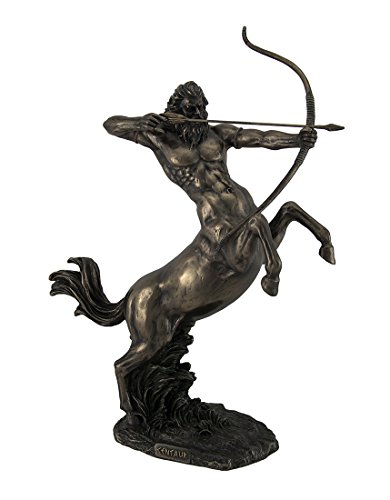
As an example, the Raising of the Mary Rose was on 11 October 1982. This turns into 111082 when the month is turned into a number and only the last two digits of the year are used. The activity was to decode information about mythological beasts and monsters. To encode, each letter in the plaintext was shifted forwards according to the number in the keyword e.g. for 111082 and Centaur, the C was shifted by 1 to make D; the e by 1 to make f; the n by 1 to make o; the t by 0 so stays as t; the a by 8 to make i; the u by 2 to make k; the r by 1 to make s. So Centaur becomes Dfotikr. Decoding means shifting backwards along the alphabet by the number in the keyword.

I gave the children a short paragraph on different mythological beasts and monsters, with the name and some of the key descriptive words encoded. Once a set of beasts was decoded I gave out a set of pictures, asking the children to match the beast with its picture.  The children enjoyed this chance to build on their knowledge of mythology from around the world.

centaur

St Thomas of Canterbury, 14 June 2019

At Bletchley Juniors Codebreaking Club this week we used the Vigenere cipher. I reminded the children about the Caesar cipher we used many weeks ago. I explained the difference between a monoalphabetic and a polyalphabetic substitution cipher, and how polyalphabetic ones are more secure, especially when they use a keyword.  I used an example to demonstrate how the Vigenere cipher works. The plaintext word I had chosen – headlice – has two e’s and they were encoded into different ciphertext letters. The ciphertext had two z’s and they encoded different plaintext letters. I pointed out the difference with the Caesar cipher, when every plaintext letter would only correspond to the same ciphertext letter.

Our activity this week was disgusting facts about the human body. The children’s eyes lit up when I told them we would be covering blood, brains and guts. The children had to decode a ciphertext word in a sentence, read the sentence and decide if it was true or false. We then told them if they were correct or not. My favourite example, which is true: when you blush, the inside of your stomach does too.

St Thomas of Canterbury, 7 June 2019

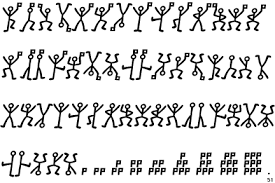
At Bletchley Juniors Codebreaking Club this week we used the Dancing Men Cipher, from the Sherlock Holmes short story of the same name.

dancing

Our activity was to make a set of Ancient Greece Top Trumps playing cards. I had made the cards, featuring an image, a description and the statistics, but without the name of the god, goddess, mortal or creature. The children had to decode the name using the cipher, then write it on the card. There were 34 cards in total, which the children completed between them. We then had a game of Top Trumps. The magic category was the most popular.  We finished with a matching pairs memory game: the pairs were all characters from Ancient Greece. These activities really helped to consolidate the children’s growing knowledge of Ancient Greece mythology.

St Thomas of Canterbury, 24 May 2019

At Bletchley Juniors Codebreaking Club this week we practised some vexillology i.e. the study of flags. I bought some Harry Potter World theme park maps. I then wrote a sequence of instructions to navigate the way around the theme park. I added North and West coordinates to the maps. I then encoded the locations of various places on the map using flag designs, with colours representing numbers. The children were able to successfully decode the flag colours as map coordinates, then read the coordinates on the map to find the location. I threw in some questions about each location, to extend those children who were Harry Potter fans. The other children enjoyed the combination of flags and maps, and having their first go at reading map coordinates.