Deforming a doughnut into a coffee mug at the Curious Minds Club (St Thomas of Canterbury Primary School, 20 September 2019)

A continuation of our exploration of topology. An explanation of the rules of deformation (no new holes, no filling in holes, no gluing, no tearing), followed by getting out the modelling clay and deforming a torus (or doughnut) into a coffee mug. An extension of this by deforming a two-hole torus into a pair of pants, and a three-hole torus into a vest (after explaining why a vest has three holes).

A new activity to demonstrate that topology includes changing an object’s shape without changing its size. Cutting a hole the size of a 5p in a piece of paper, trying to pass a 2p through this hole, finding this is impossible in 2D space, switching to 3D space by lifting up the piece of paper and introducing height, and finding that the 2p will pass through the hole once the paper is twisted and manipulated.

Introduction to topology at the Curious Minds Club (St Thomas of Canterbury Primary School, 13 September 2019)

The first week of my brand new Curious Minds Club!

An explanation that maths is about more then numbers and sums: it is also about shapes and space. A demonstration of the difference between the two and three dimensions of space. An introduction to topology. An exercise with a piece of rubber (cut out of a balloon) with a circle drawn on it, stretching it into different polygons. An exercise with the upper case letters of the alphabet, categorising them by their number of holes. An explanation of the difference between a hole and an opening, using a pipe cleaner, with the objects being those classical to topology – a doughnut and a coffee mug. An exercise with a bag of objects, with the children categorising them by their number of holes, either 0, 1, 2 or >2.

St Thomas of Canterbury, 12 July 2019

This was our final week at Bletchley Juniors Codebreaking Club!

After our mammoth attempt at some frequency analysis last week we took it easier this week by playing some board and card games requiring the solving of secret clues: Mastermind and Cat Crimes. We played Ghost Blitz, as it is one child’s favourite game. We played Zeus on the Loose as it features the Ancient Greek Gods and Goddesses!

I think it is important to mark the endings of things, so I invited the parents to come at the end for a short ceremony. I said thanks to: Mrs Sanderson for letting us run the club; Anna for helping me to run the club every week; the parents for their support; and the children for helping to make it so much fun. I gave out certificates of achievement to all the children, along with a spy pen, a personalised pencil and a small gift of a book to suit their interests. As I am a qualified librarian I could not help but give a recommendation for a book to build on our learning about Ancient Greece: Greek Myths by Marcia Williams.

This is the last blog post about Bletchley Juniors Codebreaking Club. What an amazing journey we went on!

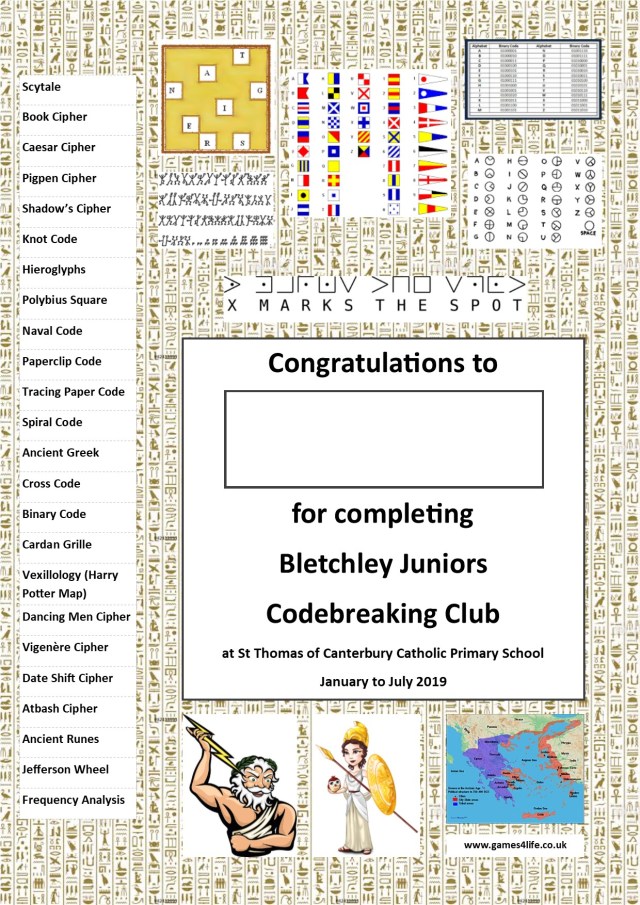
Certificate of Achievement

St Thomas of Canterbury, 5 July 2019

This was our showpiece week at Bletchley Juniors Codebreaking Club, as we tackled some frequency analysis. I promised the children I would show them how to decode a ciphertext without knowing the key, and this was it.

The plaintext was three paragraphs summarising what the children had learnt in the six months since we started this club. I used a Caesar cipher with a shift of 7, but kept this information from the children. (Why 7? It was a lucky number to the Ancient Greeks!). I explained that some letters in English texts occur much more frequently than others (E, T, A and O) and others letters occur very infrequently (X, Q and Z). I showed them a frequency distribution chart of the whole alphabet.

I got the children to count the frequency of the letters in the ciphertext. I wrote the answers on post-it notes. The children then arranged these in order: the most frequent were L, A, H and V.  I suggested it was very likely that L represented E, A was T, H was A and V was O. The children found every L in the ciphertext and wrote E above it. They repeated this for A, H and V.  I said it was very unlikely there would be an exact match between the frequency of our ciphertext and the frequency of English texts. I steered them towards a list of the most common three letter words that I had supplied them with. The children could predict where the word ‘the’ was in the ciphertext: they then found every O and wrote H above it. Returning to the list of three letter words, the children could predict where the word ‘and’ was in the ciphertext; they then found every U and wrote N above it, and found every K and wrote D above it.

From this point on it was a case of pointing the children towards some partially complete words in the ciphertext and encouraging them to work out what that word was, then transferring this knowledge to all of the ciphertext. There was a point when we felt we had reached the summit of the mountain, and it was all downhill from there. Eventually I was able to read out the whole plaintext message.

One thing that did not go well was the timing: we over ran by 20 minutes, as it proved impossible for me to predict how long the activity would take. I did gently push the children to get the activity finished before leaving. The lesson I learnt was that I could have split the activity across two weeks, or I could have written a shorter plaintext. Perhaps I was too ambitious: you live and learn.

One other thing to bear in mind was that it is very easy to miss letters when counting them, and when looking for them to write the real letter above them. I did this in practice, and the children did it during the session. I think the solution is to know that this will happen and to allow time to check the children’s work as they go along.

As we over ran there was no time to summarise what we had achieved in the session. One parent did tell me later that their child was intrigued by frequency analysis. It was good to know we had provided another enjoyable session.

St Thomas of Canterbury, 28 June 2019

At Bletchley Juniors Codebreaking Club this week we tried three new ciphers!

Our first was the Atbash cipher. I encoded a group of words and asked the children to work out the connection between the words. I used these groups: DC Comics superheroes, the sun, the moon, and the Seven Wonders of the Solar System. This last one had a ‘match the picture’ round. I explained that I chose the moon as it is nearly 50 years since a man first landed on the moon. The words in my moon group were: full, half, Apollo, lunar, crescent, gibbous, waxing and waning.

The second was the Jefferson cipher wheel. I was in possession of a replica wheel. I showed the children that each disk has a random sequence of each letter of the alphabet, which can be removed and replaced in an agreed order. The plaintext is then spelled out on one row of the wheel. Every other row will look like gibberish. One of these rows is chosen as the ciphertext. The recipient of the coded message sets their wheel to the ciphertext and turns the wheel around until they find the one row which make sense, which is the plaintext. The activity was to decode the Seven Wonders of the Ancient World, then match each to its picture. The children found it quite hard to manipulate the wheel: some of the disks were stiff and hard to turn, and others were a little too loose. This made it hard to line up each row in a straight line. With some help the children were able to decode the Great Pyramid of Giza and the Colossus of Rhodes. As we were running out of time I read out the names of the other five wonders, and we went straight to the pictures to match everything up.

Our third cipher was the Ancient Runes. There were some mythological beasts and monsters that we did not have time to look at last week, so I reused them and encoded them in the Runes. I do love a ‘match the picture’ round so included one here. After decoding such beasts as the Basilisk, Manticore, Chimera, Werewolf and Griffin the children were successful in matching it all up.

werewolf