Newport, 23 November 2018

Today at our Board Games Club for Adults we hosted the world premiere of ‘Picaria Quad’, a game we invented as a family on 18 November 2018. This variation on Picaria gives each player four counters and the winner is the first to make a square or rectangle. This game is part of our collection of board games that we will be selling soon. We are appearing at two primary school Christmas fairs, and people can try the games in the collection before buying them: they make excellent Christmas presents!

We also played some five in a row games. The first was Cavendish (Hiron Ltd, 1986) invented by Maureen Hiron. The winner is the first player to make a five in row. Unlike most ‘n in row’ games this one has a capture rule: if they are in a straight line, you can jump one of your counters over two of the other player’s counters and remove them. Although if you do too much capturing your counters will be spaced far apart and it will be harder work to make your five in a row.

We also played Cambio (Lagoon, 1996), another 5 in a row game by Maureen Hiron. There are wooden cubes which have a different symbol on each of the six sides. The cubes are arranged in a 5×5 grid. Each player selects a symbol, then pushes a new cube in from one side of the grid, moving each cube along by one and pushing a cube out of the other side. The limitation is that you are not allowed to push the player’s symbol out of the grid.
St Thomas of Canterbury, 16 November 2018

We started with Hex. It is a game which is easy to describe but not necessarily easy to play. It was invented by the Danish mathematician Piet Hein in 1942. It was independently invented by mathematician John Nash in 1947 at Princeton University. The board is a rhombus shape. Players must connect two opposite sides with pieces of their colour. There is a mathematical proof that this game cannot end in a draw. There are lots of resources online describing the strategy. You can play Hex online.

It is very difficult to buy this game so I printed paper boards. This might have been one reason why the children were reluctant to play it for too long. We moved on to Bridg-It (Hasbro, 1960). This variant of Hex was invented by mathematician David Gale. Players attempt to build a continuous connected bridge of their colour from one side of the board to the opposite side, while blocking their opponent from doing the same. When testing this game I could see the similarity to Hex and wondered if a game could ever end in draw. I searched online and found that the only way a bridge can be completely blocked is by completing a bridge of the opposite colour: draws are therefore impossible. You can play Bridg-It online.

Our final game was Quoridor (Gigamic, 1997). The aim is to be the first player to reach the opposite side of the board. On each move a player has two options: moving their pawn one square, or placing a fence. If you place a fence you can obstruct the other player and slow them down, but if you are not careful you can end up obstructing yourself. I will write more about this game when I have further explored games on the theme of mazes and labyrinths.

Newport, 16 November 2018

There are some weeks when you feel like letting the dice do some of the work for you, and this week was one of those.

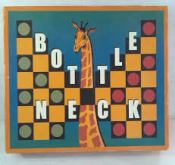
We played Bottleneck (Gazebo Games, 2006). According to Board Game Geek this game “is from Pepys of England and probably originated in the mid 1940’s”. I have a modern reproduction from 2006. Players take turns moving their counters across the board according to the number on the die. Both players have to move through the bottleneck. The first to move all their counters to the other player’s starting position is the winner. This game is a replacement game, like Chinese Chequers, Halma and Five Field Kono.

bottleneck

There is a picture of a giraffe on the box. I like the humour here: the board resembles a Draughts board; Draughts sounds like giraffe; a giraffe has a long neck.

We played Joggle (Green Board Game Company, 2010). This game is played on a 8 x 8 board where the winner is the first to make a 2 x 3 rectangle of their coloured marbles (black or white), and the board is indented with four colours (red, blue, green and yellow) with a dice throw determining which colour your marble is placed on, and if the die lands on a ‘joggle’ you get to choose any colour for your marble. We also played Tri It! (Spears, 1995) which we first played last week. We finished off with Pass the Pandas, because I got it for my birthday and I love these fast paced family games.

Christmas present ideas

A friend asked me recently for some ideas for a board game to buy for a family member, which were “not Monopoly or the Game of Life”. I thought I would turn it into a blog post.

Some of these games I own, and some I don’t. If you buy one, I will not benefit financially.

BOARD GAMES

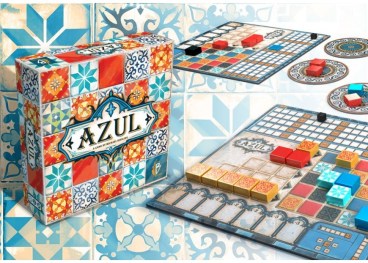
Azul   If you like Moorish art, this tile laying game will appeal to you.
lg-b-azul-announcement

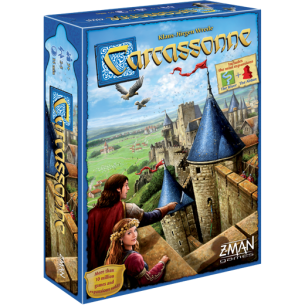
Carcassone   Develop the landscape of a medieval fortress city one tile at a time.
zm7810_box_front

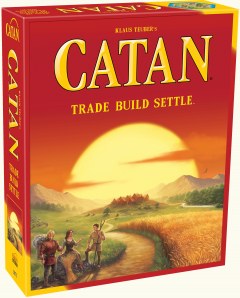
Catan   Try to be the dominant force on the island of Catan by building settlements, cities, and roads.
catan

Ingenious   The game of vexing and perplexing hexagons.
ingenious_box_3d_front

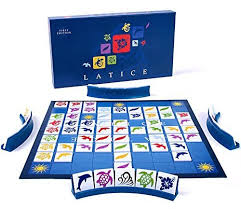
Latice   Match tiles by colour and shape.
lattice

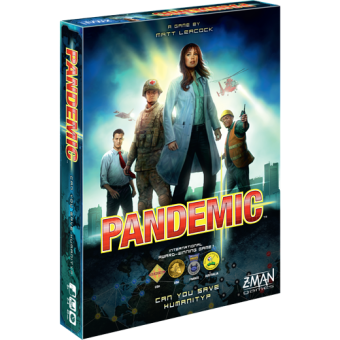
Pandemic    A cooperative board game in which players work as a team to treat infections around the world while gathering resources for cures.
zm7101_box_front

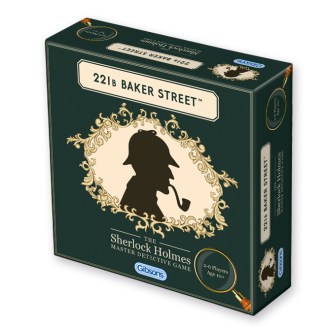
221B Baker Street   Start at 221B and travel through the streets and alleys of London picking up clues and attempting to solve the most intriguing cases Holmes and Watson have ever faced.
G778-221b-Baker-Street-2014

CARD AND DICE GAMES

Ghost Blitz   A brilliant reaction game in which quick eyes and quick hands are crucial.
GhostBlitz01_150x@2x

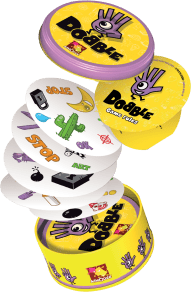
Dobble   A visual perception game in which players race to find the one matching symbol between two cards.
ASMdobble

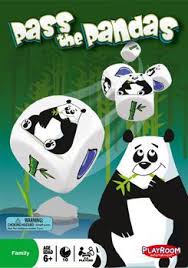
Pass the Pandas   Get rid of your dice before the other players. Roll water and it evaporates away from your stash, roll as much bamboo as the previous player, or you’ll be stuck with theirs, and roll a panda and pass it to another player.
pass pandas

St Thomas of Canterbury, 9 November 2018

Our theme this week was Tetrominos. We first played Jenga: Tetris (Hasbro, 2013). Each child tried to build the highest tower with the 47 pieces. The winner reached a height of 27 layers. The children then took it in turns to build the tower, before removing a piece and placing it on top. Because the pieces are tetrominos it is harder to get them out.

We then played Block Builders (Marks and Spencer), which uses six tetromino shapes. There are two games in one box. In Block Rows, the aim is to complete rows and score points. In 4 Square, one player is red and the other blue: the aim is to make a 2 x 2 square or a 4 in a row of your colour and score points. A spinner dictates which shape the player must pick up and use.

As Block Builders includes making a 4 in a row it seemed logical to end with Connect 4. We experimented by letting the children choose whether to make a 2 x 2 square or a 4 in a row of their colour, and by using all 42 pieces. It ended in an honourable 3-3 draw.

We are now on Twitter