Newport, 16 November 2018

There are some weeks when you feel like letting the dice do some of the work for you, and this week was one of those.

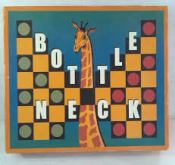
We played Bottleneck (Gazebo Games, 2006). According to Board Game Geek this game “is from Pepys of England and probably originated in the mid 1940’s”. I have a modern reproduction from 2006. Players take turns moving their counters across the board according to the number on the die. Both players have to move through the bottleneck. The first to move all their counters to the other player’s starting position is the winner. This game is a replacement game, like Chinese Chequers, Halma and Five Field Kono.
bottleneck

There is a picture of a giraffe on the box. I like the humour here: the board resembles a Draughts board; Draughts sounds like giraffe; a giraffe has a long neck.

We played Joggle (Green Board Game Company, 2010). This game is played on a 8 x 8 board where the winner is the first to make a 2 x 3 rectangle of their coloured marbles (black or white), and the board is indented with four colours (red, blue, green and yellow) with a dice throw determining which colour your marble is placed on, and if the die lands on a ‘joggle’ you get to choose any colour for your marble. We also played Tri It! (Spears, 1995) which we first played last week. We finished off with Pass the Pandas, because I got it for my birthday and I love these fast paced family games.
Christmas present ideas

A friend asked me recently for some ideas for a board game to buy for a family member, which were “not Monopoly or the Game of Life”. I thought I would turn it into a blog post.

Some of these games I own, and some I don’t. If you buy one, I will not benefit financially.

BOARD GAMES

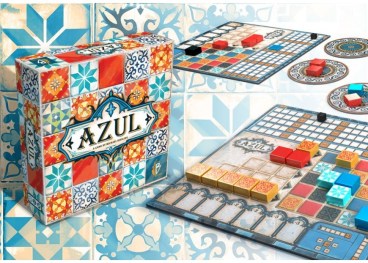
Azul   If you like Moorish art, this tile laying game will appeal to you.
lg-b-azul-announcement

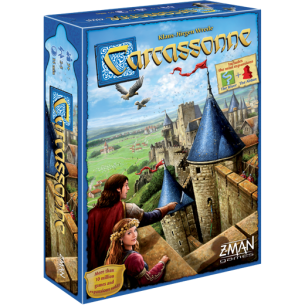
Carcassone   Develop the landscape of a medieval fortress city one tile at a time.
zm7810_box_front

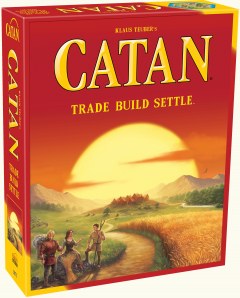
Catan   Try to be the dominant force on the island of Catan by building settlements, cities, and roads.
catan

Ingenious   The game of vexing and perplexing hexagons.
ingenious_box_3d_front

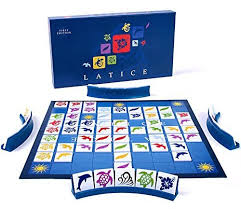
Latice   Match tiles by colour and shape.
lattice

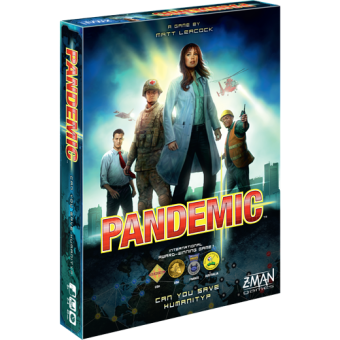
Pandemic    A cooperative board game in which players work as a team to treat infections around the world while gathering resources for cures.
zm7101_box_front

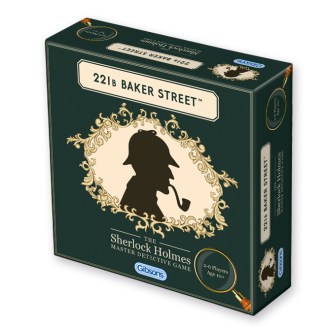
221B Baker Street   Start at 221B and travel through the streets and alleys of London picking up clues and attempting to solve the most intriguing cases Holmes and Watson have ever faced.
G778-221b-Baker-Street-2014

CARD AND DICE GAMES

Ghost Blitz   A brilliant reaction game in which quick eyes and quick hands are crucial.
GhostBlitz01_150x@2x

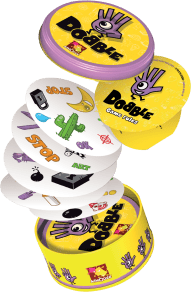
Dobble   A visual perception game in which players race to find the one matching symbol between two cards.
ASMdobble

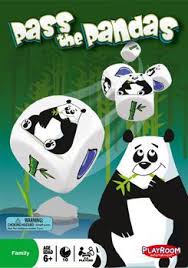
Pass the Pandas   Get rid of your dice before the other players. Roll water and it evaporates away from your stash, roll as much bamboo as the previous player, or you’ll be stuck with theirs, and roll a panda and pass it to another player.
pass pandas

St Thomas of Canterbury, 9 November 2018

Our theme this week was Tetrominos. We first played Jenga: Tetris (Hasbro, 2013). Each child tried to build the highest tower with the 47 pieces. The winner reached a height of 27 layers. The children then took it in turns to build the tower, before removing a piece and placing it on top. Because the pieces are tetrominos it is harder to get them out.

We then played Block Builders (Marks and Spencer), which uses six tetromino shapes. There are two games in one box. In Block Rows, the aim is to complete rows and score points. In 4 Square, one player is red and the other blue: the aim is to make a 2 x 2 square or a 4 in a row of your colour and score points. A spinner dictates which shape the player must pick up and use.

As Block Builders includes making a 4 in a row it seemed logical to end with Connect 4. We experimented by letting the children choose whether to make a 2 x 2 square or a 4 in a row of their colour, and by using all 42 pieces. It ended in an honourable 3-3 draw.

We are now on Twitter


Newport, 9 November 2018

This week at our Board Games Club for Adults we played a 4 in a row game you might have heard of (Connect 4) and a 5 in a row game you might not of: Pentago. On their turn each player does two things: add one marble of their colour to the board, then twist one quadrant of the board through 90º. The game board is constantly changing, and the key is to set up the board so that you twist it to make a 5 in a row on your next move, hoping the other player cannot see what you are about to do.

We also played Tri It! (Spears, 1995). A role of the die tells the player which colour line (yellow, green or blue) to move along. The aim is to get your three counters around a triangle and score the number of points shown inside the triangle. The first to 10 points wins.

Our other  game was The Knot Game (The Works). Players are dealt a set of tiles which they take turns to lay down. They must link to a rope already laid down by matching the colour. The winner is the first to lay all their tiles.

St Thomas of Canterbury, 2 November 2018

Our theme this week was making squares. Appropriate then that our first game was Squares (Waddingtons, 1982). This is a three dimensional version of the game sometimes called Dots and Boxes which is played on paper. The grid is 4 x 5, giving a total of 20 squares. Initial set-up has all the blocks turned to red on one side, and white on the other side. The player who is looking at red has to make a white square, and vice versa. Players take it in turns to swivel one block. Whoever swivels the last block to make a square claims it with a peg of their colour. The winner is the first to make 11 squares ((20 ÷ 2) + 1): sorry could not resist a bit of maths. As there are 20 squares in the grid this game could end in a draw. The strategy is to avoid turning two blocks into three blocks, or the next player will turn three blocks into four blocks and make a square. As with so many of these abstract strategy games it is about being able to anticipate how your next move will change the game board, and stop yourself from making that move if it is not to your advantage!

Our second game this week was Territorie (Invicta, 1979). (Aside: Invicta made Mastermind, Anna’s favourite game and one the children really enjoyed last year). (Second aside: am I alone in being bothered by the spelling of this game with an ‘ie’ at the end and not a ‘y’?). Back to the game: in Dots and Boxes and Squares, a fence/block is  permanent once played. In Territorie a player has two options: either add a new fence to the 8 x 8 grid, or swing an existing fence in any direction. When a player encloses a square with a fence on all four sides they claim it with their own colour peg.

Part way through this game there was a contagious outbreak of giggling, cause unknown. Around the same time one child noticed that the grid had started to resemble towns and villages and they started naming places on the Isle of Wight. This, combined with the giggling, unleashed an outburst of creativity and cooperation. The children decided to work together to link up the towns and villages. They got as far north as Edinburgh before our time was up. If we had longer I am sure they would have got to the north pole, and possibly off into space, such was their enthusiasm.